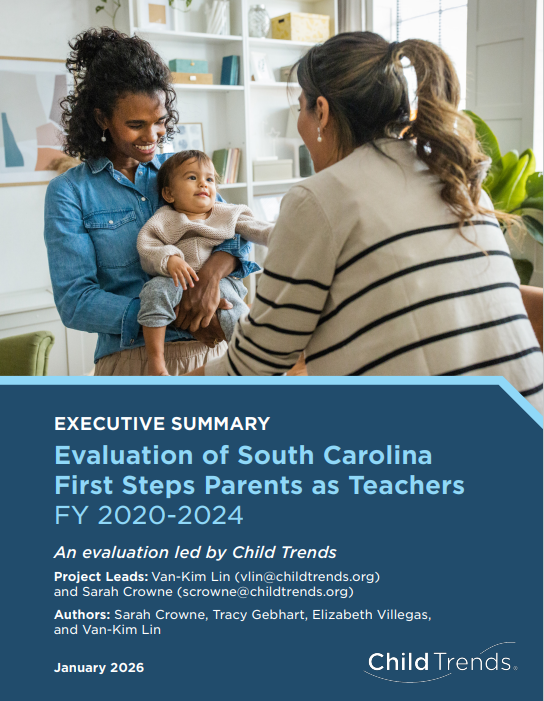
Child Trends report finds SC First Steps Home Visiting program reduces child maltreatment, boosts kindergarten readiness, and strengthens parenting, especially for families who stay enrolled longer
COLUMBIA, SC – South Carolina First Steps is releasing the results of a landmark five-year independent evaluation of its Parents as Teachers home visiting program conducted by Child Trends in partnership with the Parents as Teachers National Center.
The findings indicate that home visiting, when sustained, is among the most effective investments South Carolina can make in its youngest children. Specifically, the report found that SC First Steps’ Parents as Teachers program delivers meaningful improvements in parenting skills, reduces child maltreatment, and improves school readiness outcomes, with families who remain enrolled longest receiving the greatest benefits.
In the Parents as Teachers model, home visiting is a structured, evidence‑based approach in which trained professionals meet families in their homes or preferred settings to guide parenting, monitor child development, and connect families to resources, all aimed at promoting optimal early childhood outcomes.
“This evaluation is a testament to the incredible work happening in homes across South Carolina every single day,” said David Morley, SC First Steps Board of Trustees Chair. “As we further analyze the data from the Child Trends report, it confirms that students who fully participate in Parents as Teachers are more likely to be ready for kindergarten.”
Key findings of the Child Trends study indicated strong outcomes across the board. Of particular note are the striking differences in child abuse rates between Parents as Teachers participants and non-participants. Among children enrolled in Parents as Teachers, only 2.5 percent had a founded maltreatment report after enrollment, compared to 7.1 percent of children in the non-Parents as Teachers comparison group. That means children enrolled in Parents as Teachers were nearly three times less likely to be subjects of a maltreatment report than similar children who did not participate in the program.
Another significant finding is school readiness and kindergarten success. The evaluation found that children who received a higher “dose” of Parents as Teachers (defined as being enrolled for 12 or more months and averaging two or more visits per month) were significantly more likely to have higher kindergarten readiness scores compared to similar non-Parents as Teachers children.
Also, children who participated in Parents as Teachers were less likely to be chronically absent in kindergarten than matched non-Parents as Teachers peers. This attendance advantage was strongest among children who received a high or medium dose of Parents as Teachers services, reinforcing the importance of sustained enrollment.
Across outcomes, children with higher dosage consistently showed stronger results. SC First Steps will use these findings to intensify family engagement efforts and support longer enrollment for the families who need it most.
“South Carolina First Steps’ strong implementation of the Parents as Teachers model has produced meaningful results for children and families,” said Allison Kemner, Senior Vice President and Chief Research Officer at Parents as Teachers National Center. “This independent evaluation reinforces the extensive evidence base behind home visiting and underscores the importance of sustained engagement to achieve lasting impact.”
During the five-year evaluation period, the SC First Steps Parents as Teachers program reached thousands of South Carolina’s most vulnerable families:
- More than 6,400 home visits were delivered during the evaluation period, averaging nearly 1,300 per year.
- Almost all children received at least 1.5 visits per month; at least 75 percent received two or more visits per month, which is the recommended Parents as Teachers target.
- Children were enrolled in Parents as Teachers for an average of 16.4 months; about half of all families remained enrolled after 12 months, consistent with national estimates.
- 3,912 individual children and 3,099 individual families received at least one Parents as Teachers home visit.
- About 80 percent of local First Steps partnerships offered Parents as Teachers for at least one year during the evaluation period; nearly half offered the program every year.
- FY 2024 saw the highest number of participating children and families of any year in the evaluation period, reflecting continued program growth.
“The important findings from this report have inspired SC First Steps to consider Parents as Teachers dosage in our own evaluation and intervention designs,” said Molly Tuck, SC First Steps Director of Research and Evaluation. “For example, in an internal follow-up study we discovered that, when full participation in Parents as Teachers was paired with preschool programming, children in poverty were five times more likely to demonstrate readiness at kindergarten entry.”
The full Child Trends evaluation report is available at SCFirstSteps.org.
###
About South Carolina First Steps
South Carolina First Steps is a state agency and nonprofit organization working collaboratively to ensure that all children start school ready to reach their highest potential. There is a First Steps Local Partnership in each of the state’s 46 counties. The First Steps 4K program provides free, full-day preschool education for eligible 4-year-olds in more than 300 licensed child care centers and private schools across South Carolina. SC First Steps also serves as the convener for the state’s Early Childhood Advisory Council, resulting in high levels of collaboration between Head Start, the SC Departments of Education, Social Services, Public Health, Health and Human Services, Behavioral Health and Developmental Disabilities, the Children’s Trust of SC, the business and medical communities, and other organizations serving young children and families. For more information, visit SCFirstSteps.org.
About Parents as Teachers
Parents as Teachers builds strong communities, thriving families, and children who are healthy, safe, and learning. They match parents and caregivers with trained professionals who make regular personal home visits during a child’s earliest years in life, from pregnancy through kindergarten. This internationally recognized evidence-based home visiting model is backed by over 40 years of research-proven outcomes for children and families. Parents as Teachers currently serves over 188,000 families annually in all 50 U.S. states, 138 Tribal organizations, and six other countries. Parents as Teachers National Center, Inc. is located in St. Louis, MO. In South Carolina, Parents as Teachers is offered through SC First Steps’ network of local partnerships operating in all 46 counties. For more information, visit ParentsAsTeachers.org.
About Child Trends
Child Trends is a nonpartisan, nonprofit research organization focused on improving the lives of children, youth, and families. For more than 45 years, Child Trends has conducted research, evaluation, and analysis to inform the policies and programs that shape child and family well-being in the United States and around the world. For more information, visit ChildTrends.org.
Topics:
Home Visiting, Parenting